PVC Leather for Dining Chairs: A Material Selection Guide for Manufacturers
Table of Contents
Quick Take
If you are short on time, start here: PVC leather is a good choice for dining chairs. It is affordable, easy to wipe clean, and comes in many colors and textures. It works for most home and commercial dining chairs.
When you ask suppliers for prices, you can start with these numbers:
| Item | Starting point | Note |
|---|---|---|
| Total thickness | 0.7-1.2 mm | First check if this means total thickness or surface-layer thickness. |
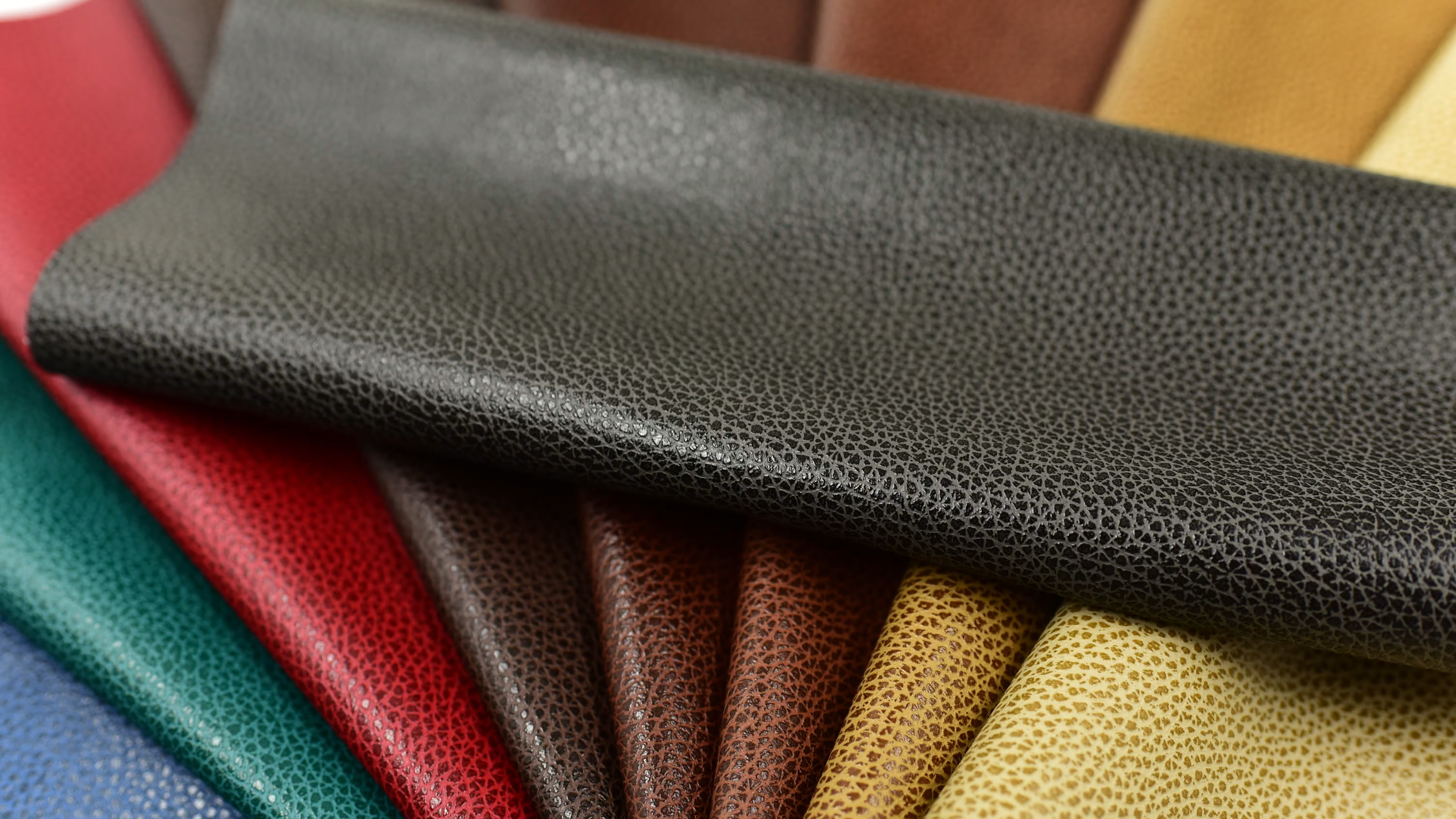
| Common textures | Lychee grain, pebble grain, fine grain, Nappa grain | Deeper textures can hold more oil and dirt. |
| Backing fabric | Knitted, woven, or brushed fabric (choose for the job) | It affects how long the material lasts and how easily it tears. Ask for the type and weight. |
| Commercial abrasion target | 50,000-100,000 Martindale cycles | Always state the test method and end point. |
| Fire safety | Confirm the needs of the target market and customer | The full chair is tested, not just one piece of fabric. |
These are only starting points for choosing a material. There is no single industry standard. Your final choice depends on the chair design, where it will be used, and what the customer will accept.
Why Is PVC Leather Commonly Used for Dining Chairs?
Think about what a dining chair goes through each day: coffee spills, sauce splashes, oily hands from children, and staff wiping the surface again and again. PVC leather has a coating over the whole surface. Most dirt stays on top, so you can wipe it off with a damp cloth. It is less likely to reach the backing fabric.
There are three main reasons to choose it:
- Costs are easier to control: It usually costs less than silicone leather and high-end PU leather.
- It is easy to clean: In busy places that need frequent cleaning, easy care saves time and money.
- There are many design choices: You can choose different textures and colors, which makes it easy to create a product line.
But keep one thing in mind: "waterproof PVC" does not mean the whole chair is waterproof. Water can slowly get into the foam and backing fabric through seams, needle holes, staple holes, edges, and corners. If the customer needs the chair to stop water from getting in, test the cover or finished chair as well. Testing the fabric alone is not enough.
PVC or silicone? Silicone leather usually offers better stain resistance and stands up better to cleaning, but it also costs more. If your main needs are easy daily cleaning, many design choices, and a lower price, PVC is a better value. For high-end hotels, medical settings, or places that need strong disinfectants, you can also compare silicone.
First, check the type of backing fabric. For PVC-coated knitted fabric used on upholstered furniture, you can refer to ISO 7617-1, PVC-coated knitted upholstery fabric (2024 edition). It covers solid PVC coatings and two grades of foamed PVC coating. If your backing fabric is woven, check the matching woven-fabric part of this series. Do not use the knitted-fabric rules for it.
How to Choose Thickness, Texture, and Backing Fabric
Thickness: 0.8-1.2 mm Is a Common Range
| Use | Suggested total thickness |
|---|---|
| Home dining chairs | 0.8-1.0 mm |
| Cafes and casual restaurants | 0.8-1.1 mm |
| Busy restaurants | 0.9-1.2 mm |
There is one question you should always ask when requesting a price: Is this the total thickness, including the backing fabric and foam layer, or only the surface layer? Many people order after looking at just one number. But two materials with the same total thickness can have very different surface layers, feel, and sewing results.
Coated fabric can be pressed down easily, so the pressure used can change the thickness reading. Ask the supplier to state how it was measured. For example, they can use ISO 2286-3, measuring the thickness of coated fabrics under the set pressure. Then you can compare results from different batches.
Texture: Looks and Ease of Cleaning Are Not the Same Thing
- Lychee grain and pebble grain: They look and feel more like leather and can hide small flaws. They are common in restaurants and cafes. Deep patterns can hold oil and dirt, so they may need more scrubbing.
- Nappa grain and fine grain: They have a smoother surface and a fine look. They are popular for modern styles and hotel dining areas.
- Fabric-like and printed textures: They look softer, but you should check how well the print sticks and how well it holds up to abrasion.
Backing Fabric: Affects How Long It Lasts and How Easily It Tears
When people choose PVC leather, they often focus on the texture and color on the front. But the backing fabric on the other side often has more effect on how long the material lasts and whether it tears. Even if the PVC surface looks great, a poor backing fabric can cause problems at the seat edge, seams, or staple points after some use.
There are three common types of backing fabric:
- Knitted backing: It stretches and feels soft. It follows curves well and works for rounded shapes. But its strength and shape stability are usually lower than those of woven backing. Check it carefully in areas that take a lot of force.
- Woven backing: Its threads cross over and under each other. It is strong, does not stretch easily, and often has better tear strength. It suits chairs that are used often. It may not fit complex curves as well.
- Brushed backing: It has a soft layer of fibers on the surface and feels thick and soft. It is also common. Its tear strength depends on the fabric type and weight, so do not assume it is strong just because it feels thick.
Also ask for the weight of the backing fabric. For the same type of fabric, a heavier backing is usually stronger, but it can also make the material thicker, stiffer, and more costly. So do not just ask, "What type of backing is it?" Ask for both the type and the weight.
To check the actual weight of the backing fabric, you can refer to ISO 2286-2, measuring the mass per unit area of coated fabrics. It can measure the total weight, coating weight, and backing-fabric weight separately. One point to note: if glue is used, the measured backing-fabric weight may be higher than the weight of the plain fabric. Do not read it as the weight of the plain fabric without checking.
Testing is still the best way to check the backing fabric. Tear strength, tensile strength, and coating adhesion (covered in Section 3) show how well the backing fabric and coating work together.
A useful sample check: Do not look only at the front. Turn it over and check the backing fabric. Bend it, and if possible, stretch it over foam to see if the pattern changes shape. Some samples look great on a table but look different once fitted to a chair. This happens quite often.
How to Test Water Resistance, Oil and Stain Resistance, and Abrasion Resistance
People often talk about these three things as if they were the same, but they are different.
1. Water Resistance: Check Whether Water Gets Through
For water resistance, you can refer to ISO 1420, the hydrostatic pressure test for coated fabrics. The test uses a set water pressure and time, then checks whether water passes through. Method A allows low or high pressure. Method B uses low pressure only.
Remember, this test checks the fabric only. You need to test seams, needle holes, and edges separately on the finished chair or cover.
2. Oil and Stain Resistance: Test Real-Life Spills
Do not test only standard stains in a lab. Try things your customers may really spill: cooking oil, soy sauce, coffee, and other drinks. Also try the cleaning products and disinfectants they use. Write down how long each one stays on the surface and how many times you wipe it. Check for marks, a sticky feel, or color changes after cleaning.
You can also ask the supplier for an ISO 105-B02 xenon-lamp light fastness report to check how well the color holds under light. This test is especially useful for restaurants near windows or in strong sunlight.
3. Abrasion Resistance: Check the Test Method Behind the Number
For commercial dining chairs, you can set 50,000-100,000 Martindale abrasion cycles as a project target. For abrasion on coated fabric, you can refer to ISO 5470-2, the Martindale abrasion test for coated fabrics (2021 edition). It has dry and wet tests and checks the coated surface.
Before using this number, keep three things in mind:
- Results from different methods, such as Martindale and Wyzenbeek, cannot be compared directly.
- The abrasive material, pressure, and end point can differ, so the results will differ too.
- The number of abrasion cycles does not equal years of use. A result of 100,000 cycles does not mean the material lasts twice as long as one with 50,000 cycles.
The test report should state the method, abrasive material, load, test sample, and end point. If any of these are missing, the number is less useful.
Do Not Skip These Other Tests
The first problems often appear at the seat edge and seams, not in the large, flat middle area. Check these performance points too:
- Coating adhesion: Will the coating come away from the backing fabric? Refer to ISO 2411, measuring the adhesion of coatings (2024 edition).
- Tear strength: Refer to ISO 4674-1, tear tests for coated fabrics (tongue and trouser methods).
- Tensile strength and elongation at break: Refer to ISO 1421, tensile tests for coated fabrics (strip and grab methods).
How to Choose for Different Places
| Place | Suggested choice |
|---|---|
| Home dining chairs | 0.7-1.0 mm, fine grain or shallow lychee grain, knitted backing, with a focus on how the material feels |
| Cafes and casual restaurants | 0.8-1.1 mm, shallow lychee grain, medium-strength backing, with a focus on easy cleaning |
| Busy restaurants | 0.9-1.2 mm, shallow embossed texture, backing chosen for strength and weight; run full abrasion, tear, and cleaning tests |
| Hotel banquets | 0.8-1.2 mm, Nappa grain or a subtle lychee grain, with a focus on color and texture staying the same between batches |
| School and institutional dining halls | Shallow texture, with a focus on cleaning-product fit and seam strength |
Do not treat fire safety as a box to tick. Fire-safety rules apply to the whole chair, including the fabric, foam, barrier layer, and chair structure. Passing a test with the fabric alone does not mean the finished chair will pass.
One related international standard is ISO 8191-1, assessing how upholstered furniture catches fire from a smouldering cigarette. It tests a combination of fabric and filling. Part 2 of the same series uses a flame like that from a match. But the standard also says that test results are only a guide. They cannot promise how finished furniture will perform.
Rules also differ by market. For example, TB 117-2013 is common in the United States. EN 1021 and BS 5852 are common in Europe and the United Kingdom. Confirm the target market's needs with the customer at the start of the project.
Buying and Inspection Checklist
First Step: Do Not Send Only a Photo
Let me share something I have seen myself.
An intermediary buyer from Southeast Asia was sourcing PVC leather for dining chairs in China for a customer in the United States. He first sent me a photo of a dining chair and asked if our factory could make custom material to match it. He also said he needed two 40-foot containers and asked for a price.
I looked at the photo, but you cannot tell how the material will perform from a picture. Different PVC leather can look much the same in a photo. The picture did not show the thickness, backing type, abrasion target, or tear-strength target. So I told him that we could not make it to the right requirements from a photo alone. He could send us a sample or tell us the material requirements.
He may have thought that was too much trouble. He did not say much more and went to ask another supplier.
This is a common example: a photo can show you the look, but not how the material will perform. If there are no performance requirements, a price is not useful, and the finished goods may not meet the end customer's needs.
Whether you are the end buyer or a buyer for someone else, include at least these items when you ask for a price:
- Sample: A real sample is best. Sending one is clearer than any written description.
- Use: Home, cafe, busy restaurant, or hotel banquet?
- Chair details: Approximate total thickness, backing type and weight, and whether there is a foam layer.
- Look: Texture and color.
- Performance requirements: Abrasion resistance (state the test method and number of cycles), tear strength, coating adhesion, light fastness, and other needs.
- Fire-safety needs: Target market and standard to follow.
- Order and delivery: Quantity, roll width, and delivery time.
If you are buying for someone else and do not know the end customer's test needs, ask for the spec sheet or test report first. It is faster than guessing back and forth.
Make These Points Clear Before You Order
- Surface finish, total thickness, backing type, and backing weight
- Texture number and color
- Usable width and roll length
- Price, minimum order quantity, sample fee, delivery time, and return or replacement rules
For roll size, state how it will be measured. You can refer to ISO 2286-1, measuring the length, width, and net weight of coated fabric rolls. When the goods arrive, compare your own measurements with the label. Do not rely only on the number printed on it.
At the Sample Stage
- Make a test chair with the real foam, seams, edge binding, and staples.
- Check if the material turns white or wrinkles at the corners.
- Wipe it again and again with the customer's cleaning product. Check for a cloudy look, stickiness, or color change.
When You Check a Large Order
- Check for color differences between nearby rolls.
- Check that the texture is the same and that there are no pinholes, bubbles, or creases.
- Check that the width and roll length match the label.
- Make sure the batch number, roll number, and test report can be traced.
One very useful tip: Do not order based on a color card alone. Take a typical roll, cut it, sew it, and fit it to a chair. This step brings many problems to light. Also agree with the supplier in advance that they must tell you before changing the resin, plasticizer, backing fabric, top coat, embossing process, or factory location.
One last reminder: ISO standards are updated from time to time. For example, the 2024 edition of ISO 2411 has replaced the 2017 edition, and ISO 7617-1 for PVC-coated knitted fabric was also updated to a 2024 edition. Before adding a standard to a contract, ask the supplier to state which year's edition they will use.
Final Note
When choosing PVC leather for dining chairs, the best material is not the one with the most impressive numbers. It is the one that fits your chair and the way your customer will use it. First, understand where the chair will be used. Then choose the thickness, texture, and backing fabric. Check your choice on a real sample chair, and make sure each large order stays the same. Follow these steps, and you can avoid most major problems.
Hualixing New Materials Co., Ltd. Manufactures both affordable PVC Leather and Water-based Eco-friendly PVC Leather. Our water-based PVC leather has passed environmental testing by SGS, a third-party testing organization. If you want to learn more,please contact us.
FAQ
Q: Is PVC leather suitable for restaurant dining chairs?
Yes. The surface finish, backing fabric, seam design, and cleaning method must all fit the place where the chair will be used.
Q: How thick is PVC leather for dining chairs usually?
The common range to ask about is 0.8-1.2 mm. First check if this is the total thickness or only the surface-layer thickness. Then confirm it on a sample chair.
Q: Are 50,000-100,000 abrasion cycles enough?
This can be an abrasion target for a commercial project, but the test method must be clear. Results from different methods cannot be compared, and they cannot be turned straight into years of use.
Q: Which is better for dining chairs, PVC or silicone?
Silicone has better stain resistance but costs more. PVC costs less and offers more design choices. Choose based on your budget and the needs of the place.
Q: Does waterproof PVC make the whole chair waterproof?
No. Water may get in through seams, needle holes, edges, and corners. The finished chair needs its own test.
Q: Can a factory give a custom price from just one dining-chair photo?
Not an accurate one. A photo shows the look, but not the thickness, backing fabric, abrasion resistance, or tear strength. Send a sample or give the material requirements so the factory can decide what it can make and how.
Q: Which ISO standards can be used for PVC leather?
Common ones include ISO 7617-1 for PVC-coated knitted fabric, ISO 2286-3 for thickness, ISO 5470-2 for abrasion, ISO 1420 for resistance to water penetration, ISO 2411 for coating adhesion, ISO 4674-1 for tear strength, ISO 1421 for tensile strength, and ISO 105-B02 for color fastness to light. Which ones you need depends on the project and customer.
Get a Free Quote
Hualixing New Materials Co., Ltd. is a factory-direct synthetic leather manufacturer with 30 years of manufacturing experience, specializing in OEM/ODM services. We manufacture and supply PVC leather, PU leather, silicone leather & vegan leather for automotive, furniture, upholstery, marine and more. Custom orders are available by yard or meter. Tell us your needs, and we will respond within 24 hours.