PVC Leather vs Faux Leather: A Complete Guide for Buyers
Table of Contents
The Short Answer
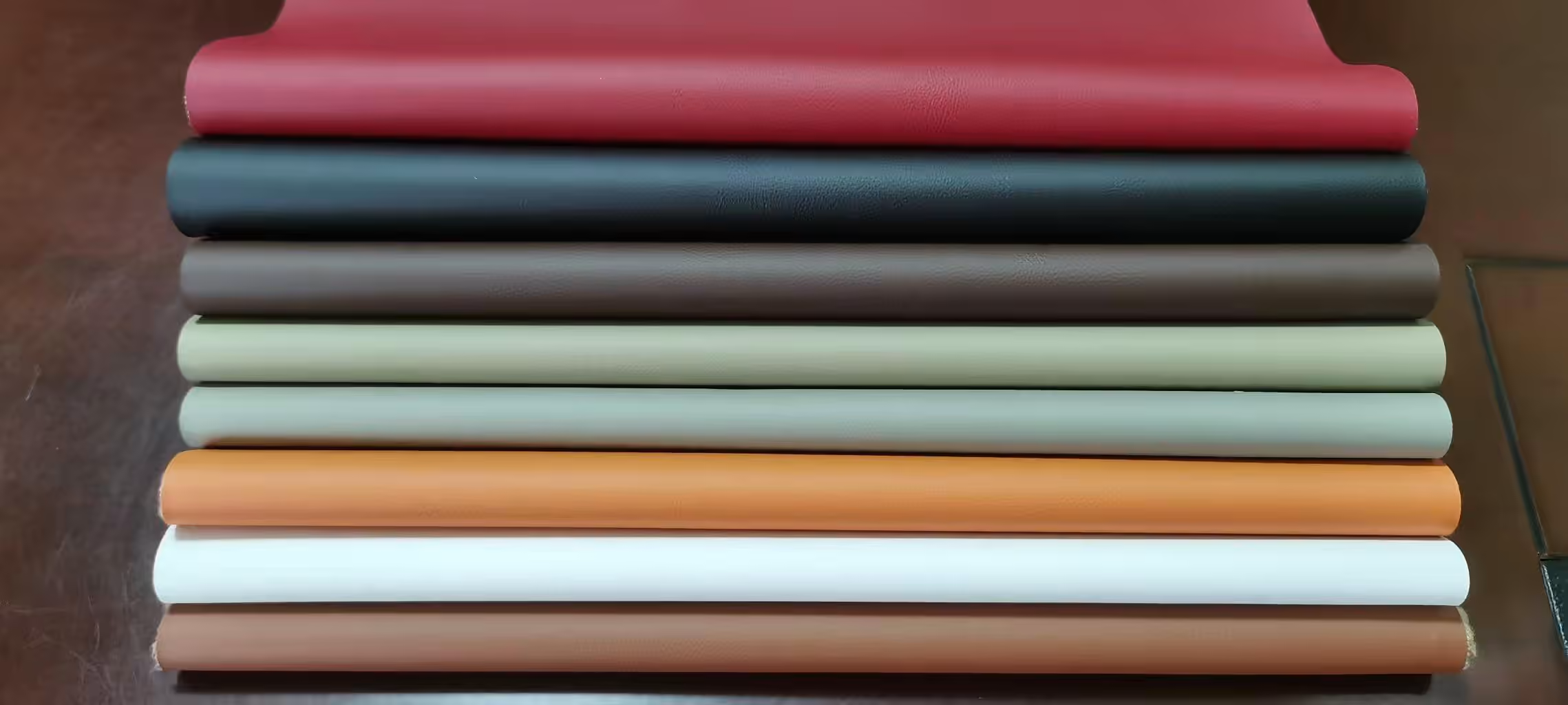
PVC leather is one kind of faux leather. "Faux leather" is a general name. PVC leather, PU leather, microfiber leather, silicone leather and bio-based leather all belong to it.
So the question "Which is better, PVC leather or faux leather?" is a little off. It is like asking "Which is better, a sedan or a car?" The right question is: how does PVC compare with PU and the other kinds of faux leather, and which one fits your product?
Here is a quick guide:
- Tight budget, need strong wear and easy cleaning, used in public places or outdoors: PVC is usually a practical choice.
- Need a soft feel and good breathability, and the material touches the body: Look at PU or microfiber first.
- Need long life against hydrolysis, low smell, or strict green rules: Look at silicone leather and bio-based leather. They usually cost more.
Let's go through these points in more detail.
How PVC Leather Relates to Faux Leather
"Faux leather" is not the name of one material. It is a group name. Any material that copies the look and feel of real leather can be called faux leather. The Wikipedia page on artificial leather lists many other names, such as leatherette, imitation leather, vegan leather, PU leather and pleather. They all point to the same big group.
These are the common types of faux leather today:
- PVC leather
- PU leather
- Microfiber leather
- Silicone leather
- Bio-based leather (often called vegan leather)
They use different coating materials, different base fabrics and different making methods. So their performance and price are very different. PVC leather is just one of them.
People outside the industry get confused here. Many think "faux leather" is one single product. In fact, it is a whole group. In some places, "faux leather" means PU. In other places, it means PVC. The same words can mean different things to different people.
Here is a real story from our factory. A new buyer from an overseas company came to choose materials. Her boss only told her, "Go and buy faux leather." She came with a pile of samples. Some were PVC and some were PU. We explained that all of them are faux leather, just made of different materials.
She was shocked. She did not know what PVC leather or PU leather was. She only knew that her company wanted faux leather. In her mind, "faux leather" was one fixed thing. So why did the samples in front of her look so different? She even worried that we were trying to trick her.
After she went home, she talked with her company for a long time. Only then did she learn that they really needed PVC leather, and that PVC and PU are both faux leather. Later, we exchanged many emails and explained the difference between each material, one by one. In the end, she chose us as her ODM for faux leather.
This was not her fault. Vague purchase requests are a trap that many buyers fall into. We will talk about this later.
Why You Should Not Treat PVC Leather and Faux Leather as Two Different Materials
If you see them as an "either-or" choice, the first result is unclear requests.
First, your quotes will be off. If you only write "faux leather", the factory does not know which kind you want. The prices can be very different. PVC and microfiber are not even in the same price range. You cannot compare the quotes side by side.
Second, the samples will not match. You want a soft, skin-friendly feel, but the supplier sends a hard, stiff PVC sample. Or you need a scrub-resistant fabric for public places, but the supplier sends a soft PU. Both sides think they are right. You send samples back and forth, and time is wasted.
Third, it is easy to miss compliance. Different materials face different chemical rules. For example, PVC needs plasticizers to become soft. Item 51 of Annex XVII of EU REACH limits four phthalates: DEHP, DBP, BBP and DIBP. Their content in plasticized material must stay below 0.1% by weight. Since 7 July 2020, this limit also covers articles used indoors or in long skin contact. You can read the original restriction text from ECHA (REACH Annex XVII), or TÜV SÜD's explanation of this change.
If your goods will be sold in Europe, write "must meet the related REACH requirements" in your purchase order. Also ask the supplier for matching test reports. Do not wait until customs to find the problem.
Your purchase order should include at least these items:
- The exact material type (PVC, PU, microfiber, etc. Do not write only "faux leather")
- The use (sofa, car seat, bag, shoe upper, etc.)
- Thickness, weight and base fabric type
- The tests and rules it must meet (abrasion, flex, REACH, etc.)
- The target market
Types of Faux Leather
First, look at the big picture. According to Wikipedia, PU-type faux leather is made in this order: make the base fabric, coat it with a PU layer, add color, and then press a texture on it. PVC is made a little differently. The common ways are calendering and coating (knife coating). PVC resin is first mixed with plasticizers, pigments and other additives. The table below gives a short comparison.
| Material | Surface coating | Base fabric | How it is made |
|---|---|---|---|
| PVC leather | Polyvinyl chloride (PVC) plus plasticizers and other additives | Usually knitted, woven or non-woven fabric | Make a film by calendering or coating (knife coating), bond it to the base fabric, then emboss |
| PU leather | Polyurethane (PU) | Knitted, woven or non-woven fabric, etc. | Coat the base fabric with PU by dry or wet processes, then add color and texture |
| Microfiber leather | Mostly PU-based resin layer | Microfiber non-woven fabric | Make a non-woven base from microfiber, soak it in PU resin, then finish the surface |
| Silicone leather | Silicone coating | Knitted, woven fabric, etc. | Coat the base fabric with silicone, cure it, then add texture |
| Bio-based leather | Resin with plant-based parts (such as bio-based PU). Many types exist | Usually fabric, sometimes other bases | The process depends on the recipe. The idea is close to other coated faux leathers |
A few more notes, so the table is easier to understand:
PVC leather: It is cheap, strong against wear, and very waterproof. It is also flexible for making patterns on the surface. The weak point is that PVC itself is fairly hard. It needs plasticizers to become soft. So the type of plasticizer and legal compliance are the key points when you buy. Wikipedia notes that making PVC depends on oil and a lot of energy, and the plasticizers are often phthalates. For background on the plastic itself, see the polyvinyl chloride page.
PU leather: It feels softer than PVC and is closer to real leather. It is the most widely used type. Polyurethane has many recipes, so quality varies a lot. Cheap PU and good PU are two different worlds. We will say more about this later.
Microfiber leather: Strictly speaking, its resin layer is mostly PU too. But the base is a microfiber non-woven fabric. Its structure is closer to the collagen fiber network in real leather. Wikipedia notes that porous artificial leather with a microfiber non-woven base is often used in clothing and is comfortable to wear. It costs clearly more.
Silicone leather: Its surface is silicone. It usually performs very well against hydrolysis, stains and aging, and it has little smell. It is often used where hygiene and durability matter, such as yachts, medical products and baby products. The downside is high cost, and fewer choices of feel and pattern.
Bio-based leather: Be careful with this term. It means the recipe contains some parts from biological sources. It does not mean "made fully from plants", and it does not mean "biodegradable". Before you buy, ask how much bio-based content it has and whether a third party has certified it.
Which Performance Matters for Which Use
Choosing a material is not about finding the "best" one. It is about finding the one that fits your use. A material that works well for a handbag may wear out in three months on a public seat.
| Use | Key performance to check | Common material choices |
|---|---|---|
| Sofas, furniture | Abrasion, flex, hydrolysis resistance, feel | PU, microfiber. PVC for a small budget or public places |
| Car interiors | Light aging, abrasion, low smell, low fogging | Automotive-grade PU, PVC, following the carmaker's standard |
| Bags | Flex, scratch resistance, stiffness, shaping | PVC, PU, microfiber, depending on the grade |
| Shoes | Flex, tear strength, breathability, fit to the foot | PU, microfiber |
| Clothing | Feel, drape, breathability, flex | PU, microfiber |
| Public seats, medical use | Scrub resistance, disinfectant resistance, waterproofing, easy cleaning | PVC, silicone, special PU |
| Outdoor, yachts | Weather resistance, mold resistance, hydrolysis resistance, UV resistance | Silicone, special PVC or PU |
The "material choices" in this table are only common practice, not the one right answer. For a real product, you still need to check the recipe and the thickness.
A few easy-to-miss performance points
Abrasion, and use the right test method. Many people get a test report, see "Martindale, so many cycles", and think a higher number is better. But note that ISO 12947-2 clearly says it does not apply to coated fabrics (including composite fabrics). For coated fabrics, surface abrasion should be tested with the ISO 5470 series, for example ISO 5470-1, which uses a Taber abraser. So when a supplier gives you abrasion data, ask first: Which standard was used? Was the coated face tested, or the base fabric? The question is simple, but many buyers never ask it.
Hydrolysis resistance (mainly for PU). PU can suffer in hot and humid places over a long time. The surface may turn sticky, crack or peel. This is a common way PU ages. If your product will be used for a long time in hot, wet regions such as Southeast Asia, or will sit in a warehouse for a long time, ask the supplier what hydrolysis tests they did and under what conditions.
Flex resistance. For parts that bend often, such as bags, shoes and sofa armrests, the number of flex cycles is a key number. Even if two materials are both marked "flex resistant", the test temperature, cycle count and pass rule may differ. Ask the supplier to write down the test conditions.
Feel and smell. You cannot measure these two fully with numbers. You must check a real sample. Pay attention to smell too. Some low-price materials have a strong plastic smell. In a closed space, such as a car or a wardrobe, it is easy to notice.
Environment and regulations. Besides REACH, each market has its own rules. Ask the supplier for matching test reports. Make sure the reports are recent and come from a qualified third-party lab.
The Bottom Line
Back to the question at the start: PVC leather vs faux leather is not a question of taking sides.
PVC leather is one type of faux leather, and faux leather is a big group. When you buy, do not write only "faux leather". Write down the exact material, the use, the test requirements and the target market. If you do this well, quoting, sampling and inspection will all go more smoothly.
Finally, here is a simple way to think about it:
- First decide where the product will be used, then decide which performance to focus on.
- Then look at your budget and set a range among PVC, PU, microfiber and silicone.
- Ask the supplier for samples and test reports, and check that the test standards suit coated materials.
- If you export to Europe or another market with compliance rules, write the rules into the purchase order from the start.
If you are choosing materials now, or you cannot tell what material your sample is, send us the use and the target market. We can help you decide which type to start with.
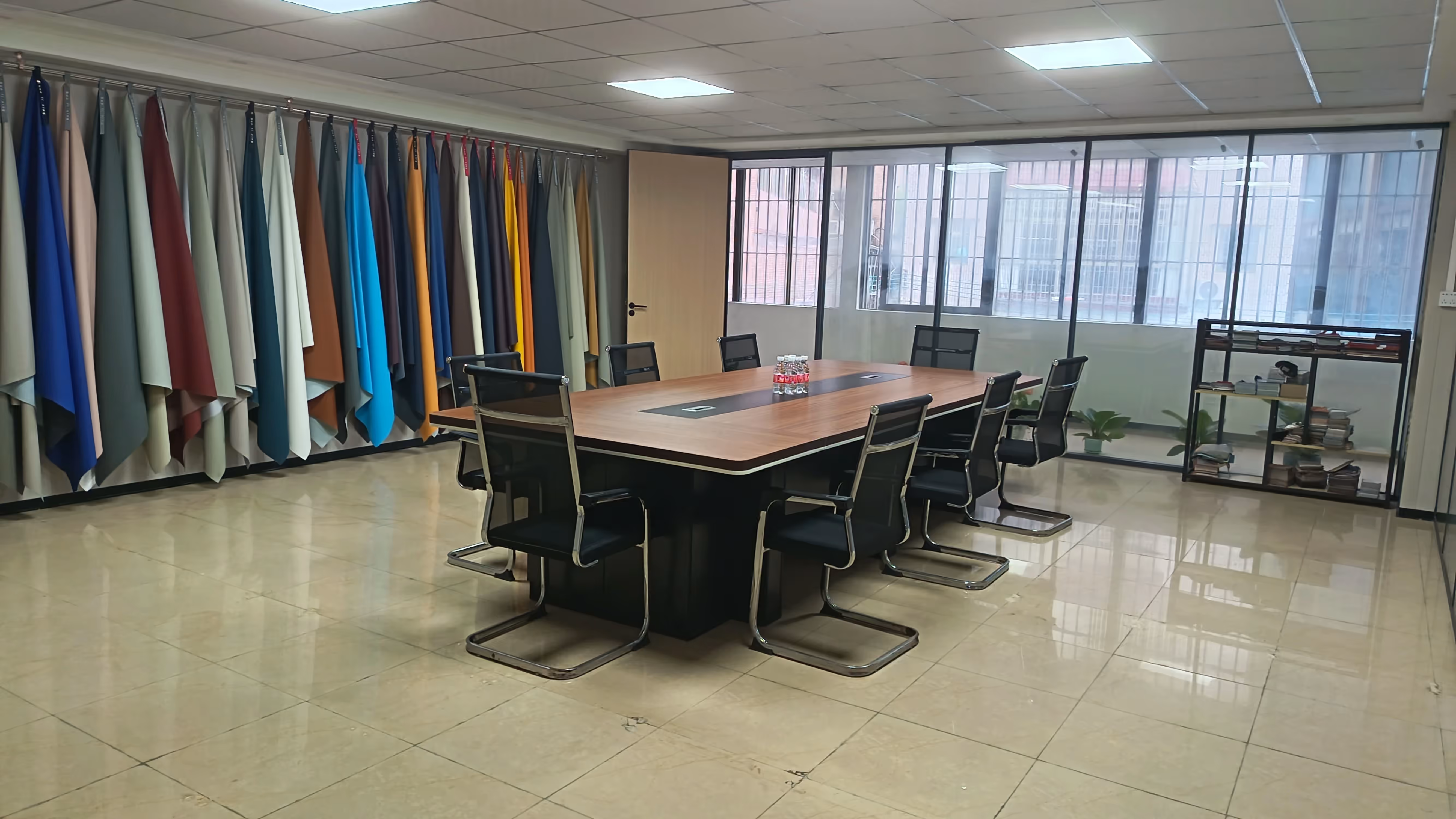
The factory of Hualixing New Materials Co., Ltd. produces all kinds of faux leather for global buyers. If you are interested, please feel free to contact us.
FAQ
Q: Are PVC leather and faux leather the same thing?
Not exactly. PVC leather is a kind of faux leather. Faux leather also includes PU, microfiber, silicone and more.
Q: Is faux leather worse than real leather?
Not always. Each has trade-offs. Real leather is breathable and has a natural grain, but it costs more and needs more care. Faux leather costs less and has stable colors and patterns, but its life span and quality vary a lot.
Q: What should I watch for with PVC leather exported to Europe?
Focus on the REACH limits on phthalate plasticizers, and keep valid third-party test reports.
Get a Free Quote
Hualixing New Materials Co., Ltd. is a factory-direct synthetic leather manufacturer with 30 years of manufacturing experience, specializing in OEM/ODM services. We manufacture and supply PVC leather, PU leather, silicone leather & vegan leather for automotive, furniture, upholstery, marine and more. Custom orders are available by yard or meter. Tell us your needs, and we will respond within 24 hours.