PVC Leather vs PU Leather: Which One Should You Choose?
Table of Contents
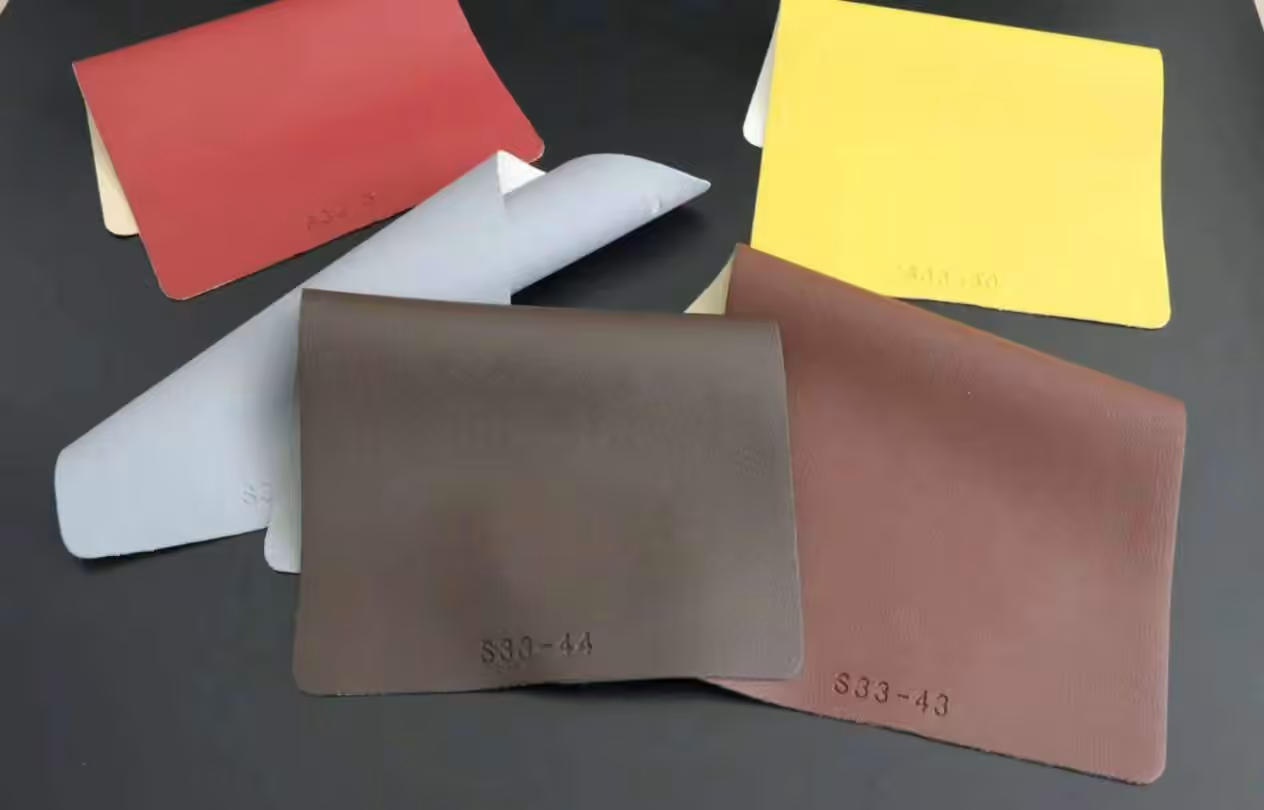
The Short Answer
I have worked in this industry for 30 years. People often ask me, "Which is better, PVC leather or PU leather?"
My answer has hardly changed. Don't ask which one is better. First, ask how much you plan to spend. At the same price level, the more money that goes into the PVC, the better the PVC is. PU works the same way. So neither material is better by nature. What decides the quality is the formula, the raw materials, and how much money is spent on the process. A PU made with cheap plasticizer, a thin coating, and skipped steps is worse than a PVC made with care. The reverse is also true.
Below, I explain the differences, how to tell them apart, and where each one fits best. After reading, you can judge for yourself.
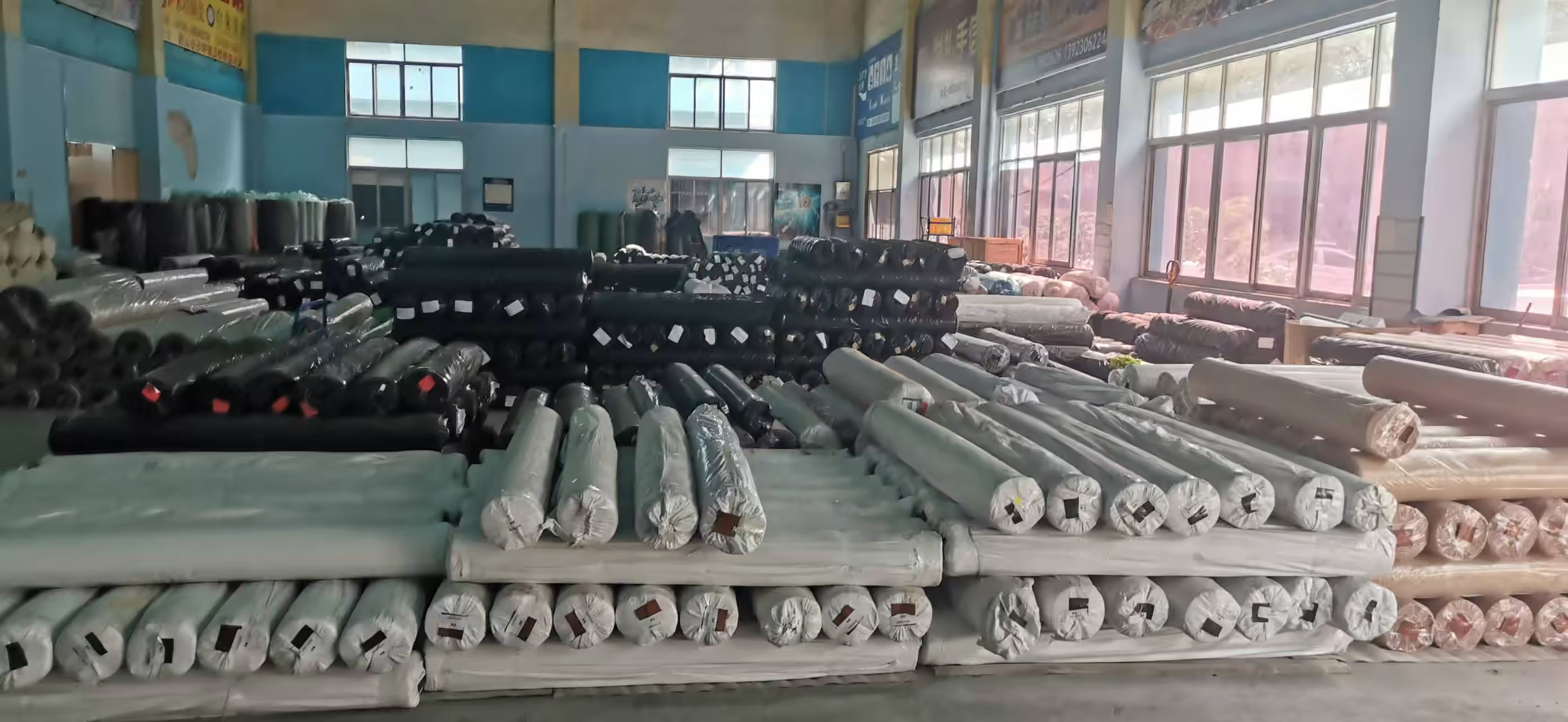
What Are PVC Leather and PU Leather?
PVC leather is artificial leather made from polyvinyl chloride. Makers mix PVC resin with plasticizers, stabilizers, and other additives. Then they coat or laminate the mixture onto a fabric base and press a leather grain onto the surface. PVC is one of the most widely used plastics in the world. Water pipes, floors, and raincoats are all made from it.
PU leather is a leather-like material with polyurethane as its main coating. Polyurethane can be made into foam, elastic material, and paint. In artificial leather, it is a layer of porous or solid PU resin on a fabric base.
Both belong to the same big family: artificial leather. Both are built in layers: a fabric base, an adhesive layer, and a surface layer. The structure is almost the same. The main difference is the material of the surface layer.
How to Tell PVC and PU Leather Apart
When a customer brings me a sample and asks, "Is this PVC or PU?", I usually follow the steps below. They go from simple to careful.
1. Look at the cross-section. Cut a small piece with a blade and look at the cut edge with a magnifying glass. The PVC surface layer is dense and even, like a solid plastic film. PU, especially wet-process PU, shows a foam-like structure with tiny holes. It has thicker layers and feels softer.
2. Touch it. Traditional PVC is harder and feels like plastic. Some types are even sticky. PU feels closer to real leather. It is smooth and dry to the touch. The difference is bigger in cold weather. PVC becomes hard and brittle, but PU stays soft.
3. Smell it. New PVC has a clear smell of plastic and plasticizer. PU often has a light smell of solvent or chemicals. Use this step only as a hint, because the smell changes a lot with the formula.
4. Burn it. Light a thin strip of the sample in a well-ventilated place.
- PVC: It has a strong plastic smell that is a little sharp. It often goes out by itself when you take it away from the flame. The smoke is rather black.
- PU: It also has a chemical smell, but it is closer to a light burnt smell. It often keeps burning after you take it away from the flame, and the edge melts.
If the material contains a flame retardant, the result can be different. So the burning test is only a first check. Also, burning PVC gives off hydrogen chloride and other irritating gases. Always do this in a well-ventilated place and protect yourself.
5. Test for chlorine (more reliable). PVC contains chlorine. PU does not. In the lab, there is a method called the Beilstein test. You heat a copper wire until it glows red, touch it to the sample, and put it back in the flame. If the flame turns green, the sample contains chlorine, and it is almost certainly PVC. The Canadian Conservation Institute has published a technical note on this method. But the test is not 100% certain, and it has some safety risks, so I do not suggest you try it at home. To get a sure answer, the safest way is to send the sample to a third-party lab for infrared spectroscopy. You can also ask your supplier for a material composition report.
Ordinary PVC Leather vs Ordinary PU Leather: Performance
| Performance | PVC Leather | PU Leather |
|---|---|---|
| Feel | ⭐⭐⭐☆☆ | ⭐⭐⭐⭐⭐ |
| Durability | ⭐⭐⭐⭐⭐ | ⭐⭐⭐☆☆ |
| Hydrolysis resistance | ⭐⭐⭐⭐⭐ | ⭐⭐⭐☆☆ |
| Cold resistance | ⭐⭐⭐☆☆ | ⭐⭐⭐⭐☆ |
| Breathability | ⭐⭐⭐☆☆ | ⭐⭐⭐⭐☆ |
| Cost | Slightly lower | Slightly higher |
This table is for ordinary products on the market. High-end formulas are not included.
Strengths of PVC leather: It lasts a long time and costs less. It resists wear and scratches, and it repels water and stains well. It suits large-volume use. Its weak points are poor breathability and a harder feel.
Strengths of ordinary PU leather: It is soft and stretchy. It breathes well, and it feels closer to real leather. Its weak point is poor resistance to hydrolysis. In a hot and humid place for a long time, it can peel and flake.
Why Does PU Go Bad? A Word About Hydrolysis
Some people buy a PU sofa, and after two or three years, the surface peels off in pieces like old skin. This is hydrolysis. The ester bonds in polyurethane slowly break when they meet water vapor and heat. Then the coating loses its grip on the fabric base. It is especially common in humid places and hot, damp summers.
The industry has international standards to test how well a material resists aging. One example is ISO 1419, which covers accelerated aging tests for rubber- or plastics-coated fabrics. It includes a "tropical" test for humid heat aging. If you buy in large volume or build a brand, ask your supplier for this kind of test report. It is much more reliable than a verbal promise.
PU also differs from type to type. Polyether-type PU resists hydrolysis better than polyester-type PU, but it costs more. So I always say: don't just ask "Is it PU?" Ask "What kind of PU formula is it?"
PVC Is Not Perfect Either
PVC needs plasticizer to be soft. Over time, the plasticizer can evaporate or move to the surface. Then the material becomes hard, brittle, and sticky. ISO 1419 even has a method to measure how much PVC-coated fabric loses when it is heated. That test is about exactly this problem.
On the environmental side, one common group of plasticizers in PVC is phthalates. The EU REACH regulation limits four of them: DEHP, DBP, BBP, and DIBP. Articles containing 0.1% or more of these in plasticized material cannot be placed on the market. See the European Commission's page on REACH restrictions. If you export, please pay attention to this. Today, most proper factories have already changed to eco-friendly plasticizer formulas for PVC.
Where PVC Leather Is the Best Choice
Strictly speaking, no use is "only for PVC." But in the cases below, PU has a hard time doing the job, and PVC is the first choice.
1. Boat and yacht seats (marine). This is the best example. At sea, the material faces strong sun, salt spray, water, and mold. It must survive all four for a long time. PVC is waterproof by nature. With UV stabilizers, anti-mold agents, and a cold-resistant formula, it can last. In this setting, PU tends to hydrolyze first and then crack.
2. Outdoor furniture and camping gear. Pool loungers, patio cushions, motorcycle seats, and camping chairs are in the sun and rain all year. PVC suits them well.
3. Hospitals, clinics, beauty salons, and massage beds. These places wipe surfaces often with disinfectant. The material must resist scrubbing, stains, and water. PVC with a disinfectant-resistant formula is a common choice.
4. Seats in public transport and public places. Seats on buses, school buses, subways, cinemas, and playgrounds are used all the time, wear out fast, and need frequent cleaning. Vehicle interior materials also need to be flame retardant. For example, the US standard FMVSS 302 sets a limit on the burn rate of interior materials in cars, trucks, and buses. PVC can meet this limit easily, and at a low cost.
5. Very price-sensitive, high-volume products. Examples are large batches of folders, ticket holders, cheap bags, and commercial seats. When the budget is small but the product must last, PVC is the more practical choice.
Where PU Leather Is the Best Choice
Again, these are not "only PU" cases. But PVC struggles to do them well, and PU is the right answer.
1. Shoes (they need to breathe). Feet sweat a lot in a day, so the shoe upper must let moisture out. PVC hardly breathes, so your feet feel stuffy after long wear. The tiny pores in PU give it the advantage.
2. Clothing, such as leather jackets, pants, and skirts. Clothes touch your body. They must be soft, hang well, and move with you. PVC is too hard and too "plastic." It is not comfortable to wear.
3. Electronic accessories that need a good touch. Phone cases, laptop sleeves, earphone cases, and keyboard wrist rests touch your hands and skin every day. The feel of PU is more pleasant.
4. Winter wear. Gloves and winter coats must stay soft in the cold. PU handles low temperatures better than PVC, and it does not become hard and brittle so easily.
Final Note
Back to what I said at the start: PVC and PU are not higher or lower than each other. The only question is which one fits.
If it will be used outdoors, at sea, or in public places, and the budget is limited, PVC is the safer choice. If it must touch the body, breathe, and feel good, PU is the better choice. Whichever you choose, remember three things:
1.Know your use environment (wet, sunny, cold, or frequently cleaned).
2.Ask your supplier for the matching test reports, such as hydrolysis resistance, abrasion resistance, flame retardance, and environmental items.
3.Don't compare only the lowest prices. Two materials can both be called PU, but if one costs twice as much, the quality can differ by more than twice.
Hualixing New Materials Co., Ltd. manufactures affordable PVC Leather, Water-based Eco-friendly PVC Leather, and Solvent-free PU Leather for buyers worldwide, with both our water-based PVC leather and solvent-free PU leather having passed environmental testing by SGS, a third-party testing organization; to learn more, please contact us.
FAQ
Q: How can I quickly tell whether I bought traditional PVC leather or traditional PU leather?
Traditional PVC leather is usually harder and feels like plastic. It can feel sticky, and it gives off a clear plastic smell when burned. Traditional PU leather feels better. It is usually smooth and dry to the touch. It also has a chemical smell, but the smell when burned is closer to a light burnt smell than PVC's.
Q: Which is more eco-friendly, traditional PVC leather or traditional PU leather?
Each has its own environmental problems. PVC involves chlorine-containing material and plasticizers. Traditional PU processes use organic solvents. Today, water-based PU and solvent-free PU processes are quite mature, and PVC also has eco-friendly plasticizer formulas. You need to check the test report of the specific product. There is no single answer for all.
Q: Does PVC leather peel?
Usually not, because PVC resists hydrolysis very well.
Q: How long does PU leather last?
It varies a lot. Ordinary PU can start to peel within one or two years in a hot and humid place. PU with a hydrolysis-resistant formula can last much longer under normal use.
Q: How big is the price difference between PVC and PU?
At the same level, PVC is usually slightly cheaper. But price depends on the formula and the process, and prices for the same kind of material can be very different. Don't judge only by the material name.
Get a Free Quote
Hualixing New Materials Co., Ltd. is a factory-direct synthetic leather manufacturer with 30 years of manufacturing experience, specializing in OEM/ODM services. We manufacture and supply PVC leather, PU leather, silicone leather & vegan leather for automotive, furniture, upholstery, marine and more. Custom orders are available by yard or meter. Tell us your needs, and we will respond within 24 hours.