What Is Semi PU Leather? Structure, Market, Uses and Benefits Explained
Table of Contents
Quick Summary
When customers first contact us, many of them start with one question: "What is the difference between Semi-PU and PU?"
Here is the short answer: Semi-PU leather is a type of composite artificial leather. It has a very thin PU (polyurethane) layer on the surface, a foamed PVC layer in the middle, and a fabric base at the bottom. It looks and feels close to PU leather, but it costs less than full PU. So it is widely used in products where price matters, such as bags, furniture and shoes.
Below, we will talk about what it is, how it is made, how the market looks, where it is used, and what its good points are. At the end, we will add a part about weak points that people often forget.
What Is Semi-PU Leather?
"Semi-PU" is a common name in the industry. It is not an official category name in the national standards. By name, the standard that fits its structure best is the industry standard QB/T 5149-2017, Polyurethane/Polyvinyl Chloride Composite Artificial Leather. You can find this standard name in the list of similar standards on the National Public Service Platform for Standards Information. For the exact scope, please read the original standard.
Here, "Semi" means that PU is only on the surface. The main body inside is still PVC.
To understand it, we first need to know the main types of artificial leather. According to the English Wikipedia entry on artificial leather, artificial leather is a material that replaces real leather. It is often used in clothing, furniture, car interiors and similar products. In China, it is usually divided into three types: PVC artificial leather, PU synthetic leather and microfiber leather. Semi-PU sits between the first two. It uses PU for the face and PVC for the inside.
Structure of Semi-PU Leather
From top to bottom, it looks like this:
| Layer | Function |
|---|---|
| Surface treatment layer | Improves wear resistance, scratch resistance and feel. It also decides whether the surface is matte or glossy. |
| PU surface layer (clear or colored, very thin) | Gives the color, pattern and touch. |
| Foamed PVC layer | Gives thickness, elasticity and a full, soft body. |
| Base fabric | Knitted fabric, non-woven fabric, brushed fabric and so on. It decides how much the leather can stretch and how well it fits a shape. |
A few details are worth mentioning:
- The thin PU layer is the cost idea behind Semi-PU. PU resin costs more than PVC. So PU is used only on the layer that customers can see and touch. The foamed PVC inside gives the thickness. In this way, the price stays low.
- The choice of base fabric matters a lot. Knitted fabric stretches well. It is good for covering curved shapes, such as sofas and seats. Non-woven fabric is flat and cheap. Brushed fabric feels thicker and softer. It is often used when the back of the product needs a good feel.
- Do not skip the surface treatment. Two products can have the same structure. But if the surface treatment is poor, the leather may start to fuzz or lose color after only a few months.
The Semi-PU Leather Market
First, a note: industry associations collect data for the whole artificial and synthetic leather category. They do not give separate numbers for Semi-PU. So the numbers below are only a reference for the larger market that Semi-PU belongs to.
- Output. According to data from the Artificial Leather and Synthetic Leather Committee of the China Plastics Processing Industry Association (collected by Huajing Industry Research Institute), China made about 4.57 billion meters of artificial and synthetic leather in 2021. Sales were about 4.48 billion meters.
- China is the center of the global industry. The same source says that China's output passed that of Taiwan, China as early as 2000. By the end of 2009, China made more than 70% of the world's output.
- Downstream uses. Shoe leather takes the biggest share, about 38.3%. Clothing leather and furniture leather are each about 17.3%. Bag leather is about 11.8%. Sports leather is about 5.2%. Car interior leather is about 3.1%.
- Production is concentrated in a few places. In the 2020 output data, Anhui made about 30%, Fujian about 22%, and Zhejiang about 18%.
- Trends. Eco-friendly synthetic leather, such as water-based and solvent-free types, is growing. Microfiber leather is also expected to do well. For Semi-PU, the pressure mainly comes from environmental compliance. The chance lies in good value for money.
These numbers are from 2021 and 2022, so they are a few years old. Before you write a plan or a quote, please check the latest numbers with the association or in the newest yearly report.
Common Uses of Semi-PU Leather
Suitcases and Bags
Stationery and Notebook Covers
Sofas, Soft Wall Panels and Headboards
Shoe Materials
Decoration and Packaging
Car Interiors
Benefits of Semi-PU Leather
✓ Good Value for Money
It has the look of a PU surface and the cost of a PVC inside. For customers who have a limited budget but do not want plain PVC, it is often a good middle choice.
✓ Softer Feel Than Plain PVC
The PU surface layer feels finer to the hand. It does not feel so much like plastic.
✓ Waterproof and Easy to Clean
You can clean it with a simple wipe in daily use. It is a good fit for furniture and bags.
✓ Many Colors and Patterns
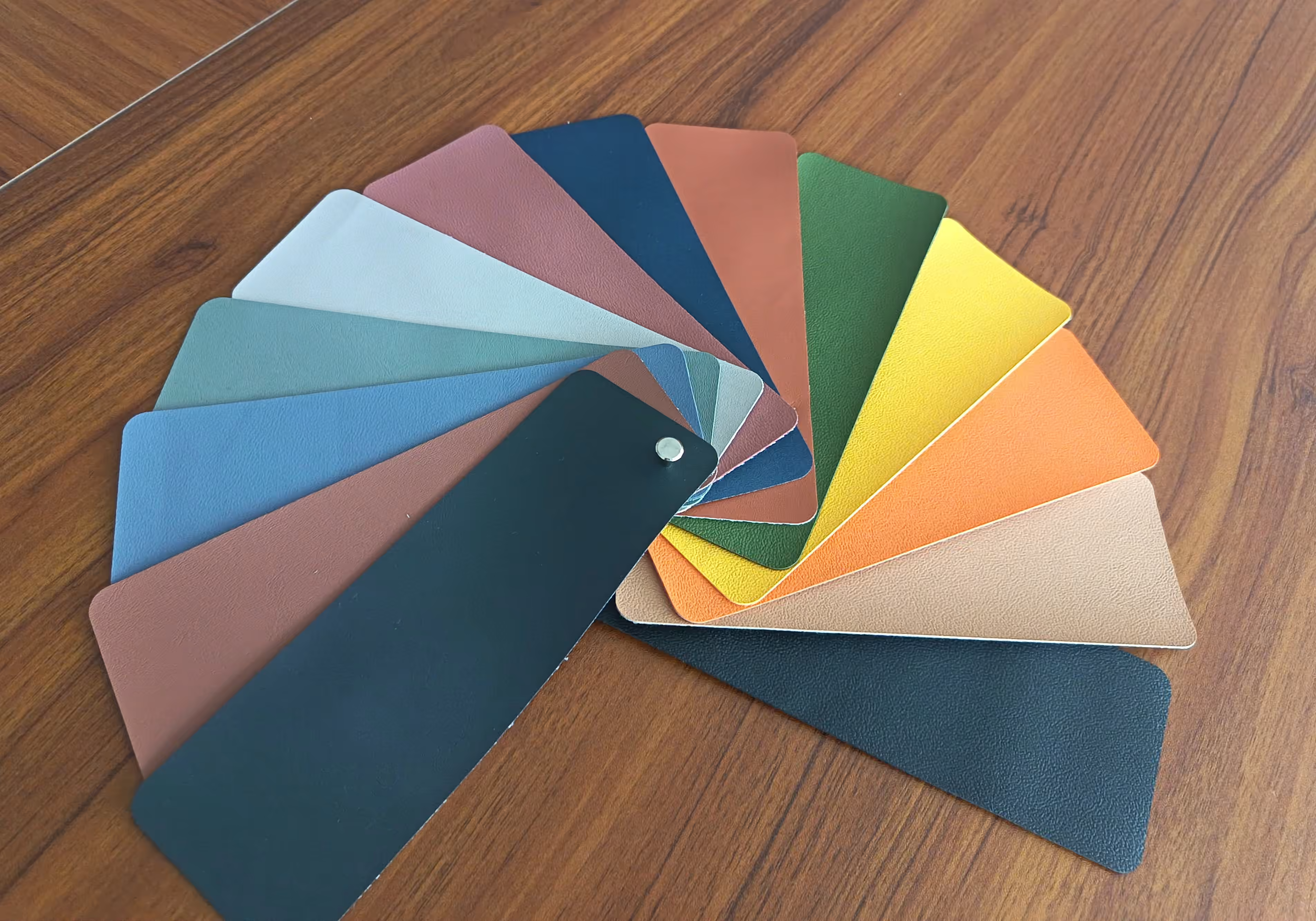
Embossed patterns, matte finishes, metallic colors, two-tone brushed effects and more. Most styles can be made.
Points That People Often Miss
1. It is less breathable than real leather and also less breathable than microfiber leather.
If you make products that touch the skin or stay on the body for a long time, you must think about this.
2. The PU layer can break down in water (hydrolysis).
In a wet and hot place, the PU layer may crack or peel after a long time. Please pay attention to the storage place and the place of use.
3. For export, check environmental compliance.
The foamed PVC layer uses plasticizers. Entry 51 of Annex XVII of EU REACH limits four phthalates: DEHP, DBP, BBP and DIBP. Their content in plasticized materials must be below 0.1%. For orders going to Europe, always ask your supplier for a test report.
4. The national standard is being updated.
The national standard GB/T 8948, Polyvinyl Chloride Artificial Leather, now has a 2025 edition. It takes effect from May 1, 2026. See the Standard Information Query of the Standardization Administration of China for details. When you write a quality agreement, please check the latest version number.
Final Words
Hualixing New Materials Co., Ltd. manufactures affordable Semi-PU leathe.If you want to learn more, please contact us.
FAQ
Q: Is Semi-PU leather real leather?
No. It is artificial leather. It has no natural leather fibers.
Q: How can I tell Semi-PU from full PU?
Look at the cross-section. In Semi-PU, the middle layer is foamed PVC. In full PU, the main body is PU resin. It is hard to tell by eye, so you need a lab test, or you can ask the supplier for a structure description.
Q: Is Semi-PU durable?
It depends on where it is used, the surface treatment and the base fabric. For furniture and bags, if you choose the right specification, it can last for several years without problems.
Q: What should I pay attention to when exporting to Europe?
The key point is restricted substances, such as phthalates. It is best to decide the test items before you place the order.
Get a Free Quote
Hualixing New Materials Co., Ltd. is a factory-direct synthetic leather manufacturer with 30 years of manufacturing experience, specializing in OEM/ODM services. We manufacture and supply PVC leather, PU leather, silicone leather & vegan leather for automotive, furniture, upholstery, marine and more. Custom orders are available by yard or meter. Tell us your needs, and we will respond within 24 hours.